
Flying Ants vs. Flying Termites: How to Tell the Difference in Your North Carolina Home
Same size. Same season. Same windowsill. One of them is a nuisance and the other one is eating your house.
It usually goes like this. Warm afternoon in March or April, a day or two after a good rain. You walk into a back bedroom you haven't used in a while and there are forty winged insects on the window glass.
Now what?
The answer depends entirely on which insect you're looking at, and the two candidates look remarkably alike from four feet away. Get it wrong in one direction and you've spent money on a problem you didn't have. Get it wrong in the other direction and a termite colony keeps working on your floor joists for another year.
The good news is that up close, they aren't actually similar at all. There are three things to check and they take about ten seconds.
The Ten-Second Check: Wings, Waist, Antennae
Get one on a piece of tape or in a jar and look at it under a decent light. Your phone camera zoomed in works fine.
1. Look at the wings
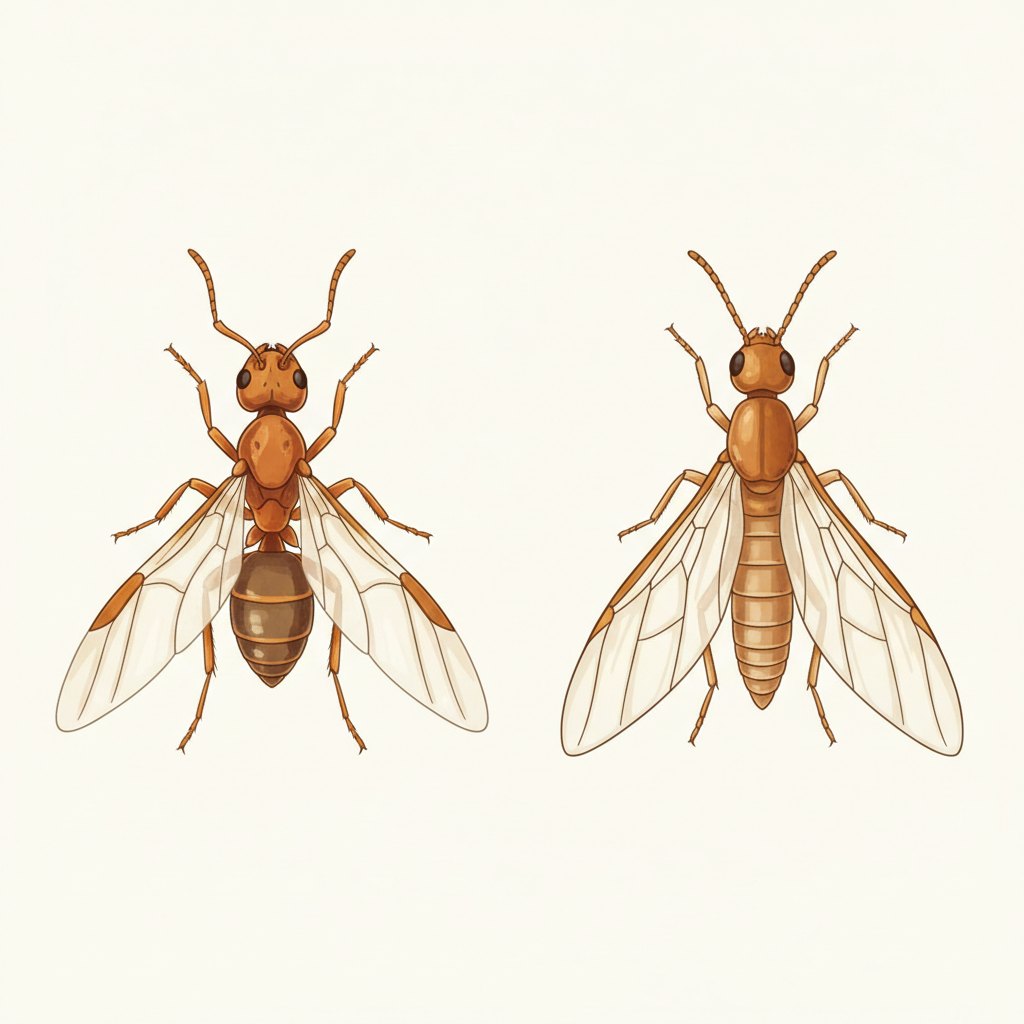
This is the fastest tell. A termite swarmer has four wings that are all the same size and shape, and they're long, often close to twice the length of the body. A flying ant also has four wings, but the front pair is clearly bigger than the back pair. Once you've seen the difference you can't unsee it.
There's a second wing clue that matters just as much. Termite wings fall off easily, and the ants' generally don't. So if you find a scatter of matched, teardrop-shaped wings on a sill or in a window track with no insects attached, that's termite evidence even if every bug is long gone.
2. Look at the waist
Ants have that classic cinched-in waist, like a wasp. Termites don't. A termite is basically a straight tube from head to tail with no pinch anywhere.
3. Look at the antennae
Ant antennae are elbowed. They bend at a sharp angle partway along. Termite antennae are straight and slightly beaded, like a tiny string of pearls.
Two out of three will usually settle it. All three will settle it every time.
Side by Side
| Flying Ant | Termite Swarmer | |
|---|---|---|
| Wings | Front pair noticeably larger than back pair | All four the same size, often about twice the body length |
| Wings shed? | Usually stay attached | Drop off easily; shed wings are a classic sign |
| Waist | Pinched, wasp-like | Straight, no pinch at all |
| Antennae | Bent at an elbow | Straight and bead-like |
| Color (common NC species) | Black or reddish brown | Dark brown to nearly black, smoky translucent wings |
| Size with wings | Varies a lot by species | Roughly a quarter to three-eighths of an inch |
| What it means indoors | A colony is nesting in or near the structure | Very likely an active infestation in or under the house |
| Urgency | Worth addressing, especially carpenter ants | Call for an inspection |
When Swarms Happen in North Carolina
North Carolina has at least three native species of subterranean termites, and they can start swarming as early as late winter and keep going into September or October. The heaviest activity most people notice runs March through May.
Native subterranean termites swarm during the day, usually on a warm afternoon following rain. That's a useful detail, because Formosan subterranean termites, which are established in parts of coastal North Carolina, swarm at dusk and into the night and pile up around porch lights. If you had a night swarm around an exterior light in late spring, mention that when you call. It changes what we're looking for.
A swarm is also brief. Half an hour to an hour and it's over. Most homeowners never witness the event at all and just find the aftermath, which is exactly why the shed wings matter so much.
Flying ants swarm on a similar schedule, which is precisely why the confusion exists. Carpenter ants tend to swarm in spring and early summer. Other species run later into the summer and fall.
Indoors vs. Outdoors: This Part Matters More Than People Realize
Where the swarm happens tells you almost as much as what the insect is.
Swarmers around a stump, a woodpile, or landscape timbers out in the yard are not, by themselves, evidence that your house has termites. Termites live in the soil all around us in eastern North Carolina. That's normal. It's a reminder, not an emergency.
Swarmers coming out inside the house are a different story. An indoor swarm usually means an infestation somewhere within the structure. Same goes for carpenter ants, incidentally. A winged carpenter ant swarm indoors generally means a mature colony is already nesting in your walls, floor, or trim, and it found moisture to do it.
Crawl space access doors, garage corners, bathroom windows, and rooms over a crawl space are where we find this most often.
"It's Just Ants" Isn't Always Good News
People relax when we tell them it's ants. Sometimes that's warranted. Sometimes it isn't.
Carpenter ants don't eat wood the way termites do. They excavate it to make nesting galleries, and they go after wood that's already soft or damp. Which means a carpenter ant problem is very often a moisture problem wearing a costume. A leaking window, a bad flashing detail, a crawl space that never dries out. Treating the ants without fixing the water just buys you a couple of seasons.
The tell-tale difference in the debris is useful too. Carpenter ants push out coarse shavings that look like pencil sharpener leavings, often mixed with insect parts. Subterranean termites leave mud. Mud tubes on foundation walls and piers, mud packed into damaged wood, dirt where dirt shouldn't be.
What to Do Right Now, Before You Call Anyone
- Save a few. A piece of clear tape pressed over three or four of them works perfectly. So does a sandwich bag or a pill bottle. Save loose wings too, even without bodies.
- Take a photo. Zoom in as far as your phone will let you and put something next to it for scale, a penny or a pen tip.
- Note where and when. Which room, which window, what time of day, and whether it had rained. All of that narrows the search.
- Don't spray them. This is the one people get wrong. Killing the swarmers you can see does nothing to the colony, because those individuals were leaving anyway. Worse, over-the-counter sprays can scatter the evidence and make it harder for a technician to trace activity back to its source.
What an Inspection Actually Looks Like
When you call X-Team Pest Solutions, the first thing we do is confirm the identification, because everything downstream depends on it. Ants and termites are not treated the same way, and no honest company should sell you a termite treatment without proving there are termites.
A thorough inspection covers:
- The crawl space or basement, including piers, sill plates, band joists, and subfloor
- Foundation walls inside and out, checking for mud tubes
- Wood-to-soil contact, cellulose debris under the house, and moisture readings in the framing
- Plumbing penetrations, expansion joints, and any spot where soil meets structure
- Windows, door frames, and trim where swarmers or wings turned up
If it's termites, we'll walk you through the options, which generally come down to a liquid soil treatment or a baiting system, and what the warranty covers. If it's ants, we'll tell you that too, and we'll point out the moisture issue that invited them in. If it's neither, you'll hear that as well and it won't cost you anything to find out.
Buying or selling? The wood-destroying insect report, which people call the termite letter, is its own process with its own rules.
Questions We Get Every Spring
I found wings but no bugs. Is that still a problem?
Yes, and it's one of the more common ways termites get discovered. Termite wings detach easily, so a pile of matched wings on a sill often outlasts the swarm itself. Bag a few and call for an inspection.
Does one swarm mean my house is infested?
Not necessarily. Swarmers outside near a stump or woodpile just mean termites are living in the soil nearby, which is normal here. Swarmers emerging inside the house are a much stronger indicator of an active infestation in the structure.
Can I just spray them myself?
You can, but it won't accomplish much. The swarmers are reproductive adults leaving the nest. The colony that matters is somewhere else, usually underground, and retail sprays don't reach it. Spraying also disturbs evidence a technician would use to locate the source.
How fast do termites actually cause damage?
Slower than the internet suggests, but steadily and invisibly. A colony can take three to five years just to mature enough to produce swarmers, which means by the time you see a swarm, the colony has been working nearby for a while. That's the real argument for acting on the first sign.
Are flying ants harmless?
Most are a nuisance. Carpenter ants are the exception, since they hollow out wood for nesting and usually signal a moisture problem behind the scenes.
Do I need a termite contract if I've never had termites?
That's a judgment call and it depends on your construction type, crawl space conditions, and how much wood-to-soil contact you have. We'll give you a straight assessment during the inspection rather than a sales pitch.
Not sure what you're looking at? Send us a photo.
Tape a couple of specimens down, snap a close-up, and get in touch. Identification is the whole ballgame with these two insects, and it costs you nothing to find out which one is on your window.
X-Team Pest Solutions • (252) 555-0199 • Serving New Bern, Havelock, Morehead City & the Crystal Coast for 25+ years. Licensed and registered with the NCDA&CS Structural Pest Control Division.
Sources and Further Reading
- NC State Extension — Termite Swarmers: What Do They Mean For You?
- NC State Extension — Monitoring and Management of Eastern Subterranean Termites
- NC State Extension — Wood-Damaging Pests publication series
- NCDA&CS — Homeowner's Guide to the Wood-Destroying Insect Report
- NCDA&CS — Structural Pest Control Section
General information only. Every structure is different, and identification of wood-destroying insects should be confirmed by a licensed professional. Always follow pesticide label directions.